
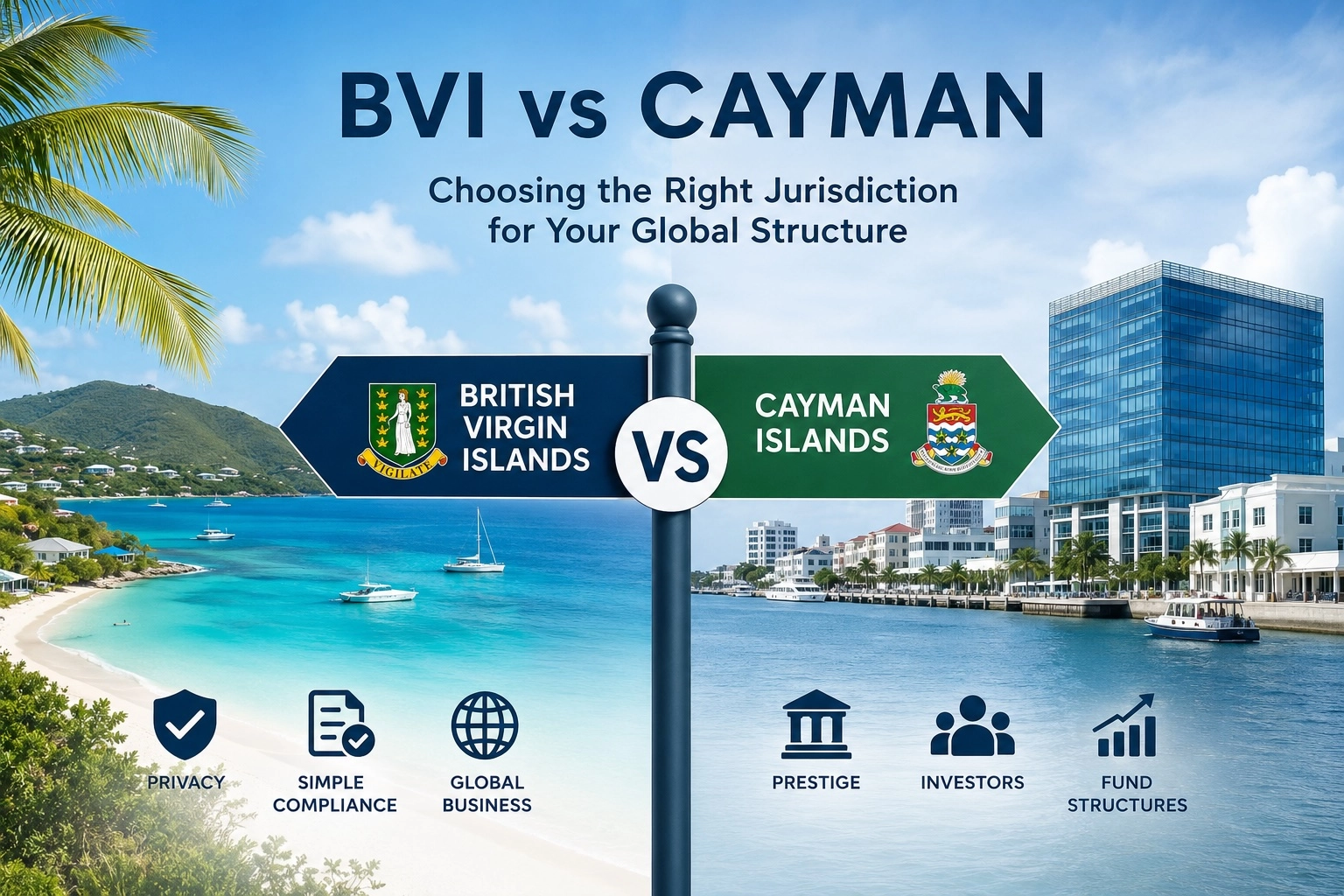
The British Virgin Islands and the Cayman Islands remain the two most widely used offshore jurisdictions in the world, together hosting well over a million active entities. Both are British Overseas Territories, both run on English common law, and neither charges corporate income, capital gains, or withholding tax. On paper they look almost interchangeable.
They are not. In 2026 the gap between them is wider than it has been in years — driven less by tax or company law and more by reputation, regulatory standing, and cost. This guide breaks down the practical differences so you can match the structure to what your business actually needs.
Before the differences, it’s worth being clear on the common ground, because much of the marketing noise treats these as distinguishing features when they aren’t:
This is where the two have genuinely diverged, and it’s the first thing a serious business should weigh.
Cayman Islands. Removed from the FATF grey list in October 2023 after completing all 63 of its action-plan items, and removed from the EU’s AML/CFT high-risk list in February 2024. As of 2026 it carries a clean regulatory standing, and its next FATF mutual evaluation (the fifth round) is expected to begin around 2026. For the purposes of EU-based counterparties and banks, Cayman entities do not trigger enhanced due diligence on the basis of any listing.
British Virgin Islands. Added to the FATF grey list (“jurisdictions under increased monitoring”) on 13 June 2025, and added to the EU’s AML high-risk list in December 2025. The grey list is not a blacklist — it carries no sanctions and the FATF explicitly did not call for de-risking or cutting off BVI clients. The Caribbean FATF has since rated the BVI compliant or largely compliant with all 40 FATF Recommendations, and removal is expected within roughly two years. But there are real consequences in the meantime: under UK and EU money-laundering rules, regulated firms must apply enhanced due diligence to transactions involving BVI entities. In practice that means more paperwork, deeper source-of-funds scrutiny, and slower onboarding.
What this means for you: if your structure mostly interacts with Asia, the Middle East, or non-EU counterparties who already know and accept BVI vehicles, the listing is a manageable irritation. If your structure needs to deal with EU banks, EU fund investors, or EU regulated counterparties, Cayman’s cleaner standing is a tangible advantage right now.
BVI Business Company:
Cayman exempted company:
If speed and administrative simplicity are priorities, the BVI generally wins. If you need the heavier regulatory architecture (for a fund, say), Cayman’s additional process is the point, not a drawback.
Both jurisdictions have moved decisively toward transparency, but neither has gone fully public.
BVI. A statutory beneficial ownership regime took effect on 2 January 2025. Beneficial ownership information is filed centrally with the Registrar of Corporate Affairs through the VIRRGIN platform, using a 10% ownership/control threshold. Existing entities had to file by 1 January 2026, with a moratorium on penalties extended to 31 March 2026. A “legitimate interest” access regime became operational on 1 April 2026: members of the public can request limited data (name, nationality, month/year of birth, ownership details) only where they demonstrate a legitimate interest such as an AML/CFT investigation. Notably, beneficial owners are notified of requests and have rights to object or appeal — a feature that drew criticism from transparency campaigners but offers individuals some procedural protection.
Cayman. Cayman operates a centralised beneficial ownership register and has implemented a legitimate-interest access model rather than a fully public one. Effective enforcement of this regime was one of the reasons Cayman cleared the FATF process. Day-to-day confidentiality remains intact, with access controlled and purpose-tested.
Bottom line on privacy: the two are now broadly comparable. Both collect ownership data centrally; both restrict public access to a legitimate-interest standard; neither shields you from regulators. If absolute secrecy is your goal, neither jurisdiction — and frankly no reputable jurisdiction in 2026 — will deliver it.
This is an underrated, very practical differentiator. Opening a corporate bank account for any offshore entity has become harder, and in 2026 it is notably harder for BVI trading entities — many European, UK, and Singaporean banks are reluctant to onboard them. A clean BVI holding company with clear beneficial ownership and a sensible activity profile can still bank successfully, particularly through banks in the UAE, Singapore, Hong Kong, and the UK that know BVI structures well. But the FATF/EU listings have added friction at exactly the moment banks are already cautious.
Cayman entities, with the jurisdiction’s cleaner standing and institutional reputation, tend to face somewhat smoother onboarding with sophisticated counterparties — though no offshore entity gets an easy pass anymore.
If banking access is mission-critical and EU-facing, factor this in heavily.
Investment funds → Cayman, almost always. Cayman is the world’s dominant fund domicile for hedge funds, private equity, and venture capital, with the deepest service-provider ecosystem and the most developed regulatory framework for mutual and private funds. Institutional investors frequently expect a Cayman structure; it signals the structure has been built properly and will survive due diligence. Note that the EU’s AIFMD 2.0 takes effect in April 2026 and continues to shape how non-EU funds market into Europe, which is part of why Cayman’s clean listing status matters for managers.
Holding companies and SPVs → BVI, usually. The BVI Business Company is the most commonly used offshore corporate vehicle in the world, with roughly 400,000 active companies. For holding shares in subsidiaries, ring-fencing assets, structuring joint ventures, or housing a single asset in an SPV, the BVI’s low cost, speed, and simplicity are hard to beat — provided the structure doesn’t depend on EU banking or institutional fundraising.
Trusts and succession planning → it depends on the objective. The BVI’s VISTA regime (under the Virgin Islands Special Trusts Act) is powerful where the trust holds shares in a BVI company and the family wants the underlying company run by its directors with minimal trustee interference — ideal for keeping a founder’s business intact across generations. Cayman’s STAR trust (Special Trusts Alternative Regime) is more flexible for purpose-led structures, family governance, dynastic planning, and commercial arrangements. The right choice follows the family’s actual goal, not the jurisdiction’s brand.
Anything institutional or capital-raising → Cayman. If you’re dealing with institutional investors, large PE groups, or any counterparty that runs heavy due diligence, Cayman’s reputation carries weight and reduces friction.
For most founders, SMEs, and ordinary global holding structures, the BVI’s reputation is more than adequate — it’s universally recognised and raises no red flags when the structure is clean and the activity makes commercial sense. Where Cayman pulls ahead is specifically in the institutional finance world. A Cayman vehicle as the client-facing or fund entity tends to be read as a signal of seriousness; a BVI entity in that same role can occasionally prompt extra questions from sophisticated institutional counterparties. The 2025–26 listings have sharpened this perception gap, at least temporarily.
Ask yourself, in order:
Neither jurisdiction is universally “better.” The right answer depends on what your entity actually does, who it has to satisfy, your compliance capacity, and your budget.
In 2026, the BVI remains the cost-effective workhorse for holding companies and SPVs, while Cayman is the premium choice for funds and any structure that must withstand institutional scrutiny. The new variable this year is regulatory standing: Cayman’s clean status versus the BVI’s grey-list and EU-list designations. That doesn’t disqualify the BVI — its companies remain fully valid and widely used — but it does add friction, particularly around EU-facing banking and counterparties, that simply didn’t exist a couple of years ago. Choose the BVI for efficiency and simplicity; choose Cayman for credibility and capital.
Disclaimer
This article is published by JAVIS HOLDINGS for general informational purposes only. It does not constitute legal, tax, accounting, financial, or investment advice, and it should not be relied upon as a substitute for professional advice tailored to your specific circumstances.
The offshore regulatory environment changes frequently. Listings, beneficial ownership and access rules, government fees, and substance requirements in the British Virgin Islands, the Cayman Islands, and other jurisdictions may have changed since this article was published. While JAVIS HOLDINGS takes reasonable care to ensure the information is accurate at the time of writing, it makes no representations or warranties, express or implied, as to its accuracy, completeness, or currency.
JAVIS HOLDINGS accepts no liability for any loss or damage of any kind arising from reliance on the information in this article. Any decision to establish, maintain, or restructure an offshore entity should be made only after taking advice from a qualified legal and tax adviser and a licensed registered agent in the relevant jurisdiction, and after considering the tax treatment applicable in your own country of residence.
Nothing in this article creates an advisory, fiduciary, or client relationship between you and JAVIS HOLDINGS.
Speak with a senior advisor about your jurisdiction, structure, and banking strategy. Consultations are confidential and complimentary.